
Onward, ho!
The Institute for the Critical Study of Antizionism

Things are happening fast. My phone has been ringing off the proverbial hook, from interested scholars, students, collaborators, some Jewish organizations, even some potential funders. There is clearly a great need for the Institute for the Critical Study of Antizionism, and a desire for it, and the time is NOW. I haven’t even officially begun to recruit scholars and my list of interested people is already above 70. I’ve been in talks with several universities as potential homes for ICSA. The excitement is palpable. If you are interested in collaborating or sponsoring, please DM me. If you know anyone who might be interested in the initiative, please direct them to this substack. And be sure to follow, on X, @InstituteCSA.
Tomorrow night (Thursday), there’s an essential webinar happening, sponsored by the fine folks at the Chai Mitzvah Scholars Circle. Prof. Norman Goda will be speaking about the history of the “Genocide Libel” against Israel, a topic right in the wheelhouse of ICSA. If you register you’ll have access to the recording even if you cannot watch it live.
Prof. Norman Goda
“Accusations of Genocide: Assessing Israel’s Right to Self-Defense”
Thursday Dec 4, 7-8 pm Eastern
Register at: https://www.chaimitzvah.org/events/accusations-of-genocide-assessing-israels-right-to-self-defense/
MARK YOUR CALENDARS:
I will launch the inaugural lecture series of ICSA with my own Chai Mitzvah Scholars Circle lecture on Tuesday December 16, 7-8 pm Eastern — stay tuned for details!
Meanwhile some key material to emphasize just why it is so essential that we redirect our efforts to studying and combating antizionism specifically — apart from whatever relationship it has precisely to antisemitism:
(1) Another important piece from the people at the Movement Against Antizionism (MAAZ) on the nature of our discourse.
(2) A piece from the great pro-Israel blogger, the Elder of Ziyon, doing the kind of work that ICSA scholars will soon be doing — to expose antizionism “scholarship” for the hateful activism that it is.
(3) A link to a terrifying podcast episode from Haviv Rettig Gur, exposing the disaster that is Wikipedia (and Reddit) — sources appearing to be neutral but in fact captured by hate-driven antizionists, and spreading their wares through the infosphere.
But first: Many people have kindly “pledged” to support this substack. But I would like to keep it entirely free. Still, if you would like to support this endeavor, and help to launch ICSA, then if you felt like buying me a coffee you would receive no objection from me: https://coff.ee/andrewpessin
=====
(1)
Today’s Dispatch: Beyond Meteorological Discourse
In today’s dispatch, we argue that contemporary Jewish responses to antizionism remain trapped in a state of inward attention that seeks to rebut individual libels rather than interrogate the ideological system producing them. This defensive mode absorbs the terms set by antizionism instead of scrutinizing the framework that generates those terms in the first place. Drawing on historical trauma, communal psychology, and comparative civil-rights models, MAAZ calls for the development of a Jewish civil-rights consciousness—one that understands antizionism not as a misunderstanding to be corrected, but as a coherent, eliminationist ideology that must be named, analyzed, and opposed with the same clarity applied to other systems of group-based hatred.

I. The Antizionist Gaze: How Jews Become the Object of Surveillance
Antizionism operates through a vigilant, surveilling gaze that treats Jews as objects to be watched, interpreted, and disciplined. This gaze monitors Jewish speech, archives Jewish behavior, polices Jewish identity, and assembles libels in which Jews appear as colonial, supremacist, genocidal, conspiratorial, or otherwise evil—charges that advance irrespective of evidence. These libels revive enduring anti-Jewish narratives, now refracted through the contemporary moral vocabularies of antiracism and decolonization rather than the older idioms of religious animus or Nazi racial purity. In doing so, the antizionist gaze positions Jews as morally suspect in advance, fixing them in an endless cycle of compelled self-justification while leaving the ideological assumptions underwriting the gaze unexamined.
(Below, notice the antizionist gaze: “WE SEE YOU…”)
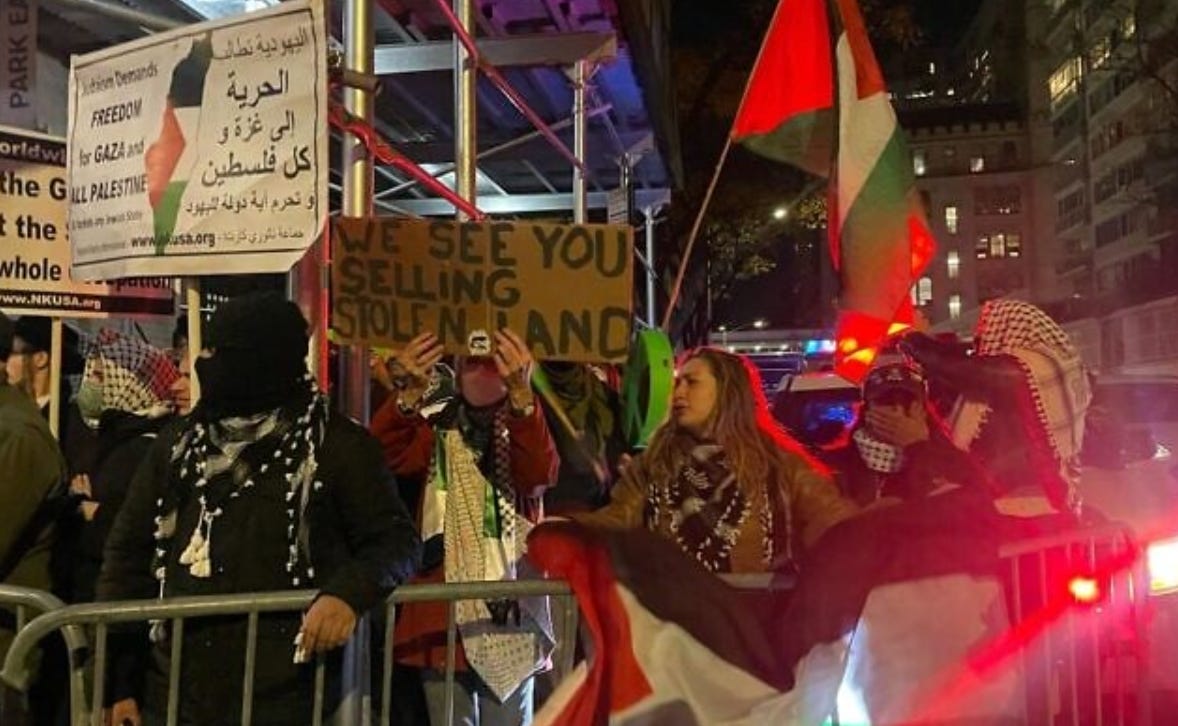
Antizionist mob at Park East Synagogue in New York City, November 19, 2025. (Luke Tress/Times of Israel)
II. The Inward Freeze: How External Violation Becomes Self-Scrutiny
Imagine a woman riding a train when a man suddenly slides his hand up her skirt. She freezes, her awareness turning inward as she scans herself rather than him. She wonders what she did to invite the violation, whether she misread the situation, whether she somehow caused it. Her attention shifts reflexively away from the aggressor and toward her own imagined culpability.
This is the motion of Jewish attention under the antizionist gaze. Rather than interrogating the ideology that targets them, Jews turn inward, searching for flaws, explanations, and proofs. They assemble documents, timelines, land claims, historical citations, and moral defenses as though preparing evidence for a trial whose verdict has already been determined. This reflex—freezing, self-examining, self-blaming—is a survival pattern shaped by centuries of danger. Yet it produces a profound asymmetry of attention: antizionists fixate on Jews, and Jews, conditioned by history, fixate on themselves as well. What remains invisible are the very structures of domination that make the violation possible in the first place.
III. Meteorological Discourse: How Language Erases Jewish Agency and Conceals Antizionist Actors
When Jews freeze under the antizionist gaze, they begin using a vocabulary of atmosphere rather than agency. Instead of identifying who is targeting Jews and why, they often describe anti-Jewish hate as though it were weather. We hear phrases like:
“It’s getting bad”
“Antisemitism is rising”
“This campus is terrifying.”
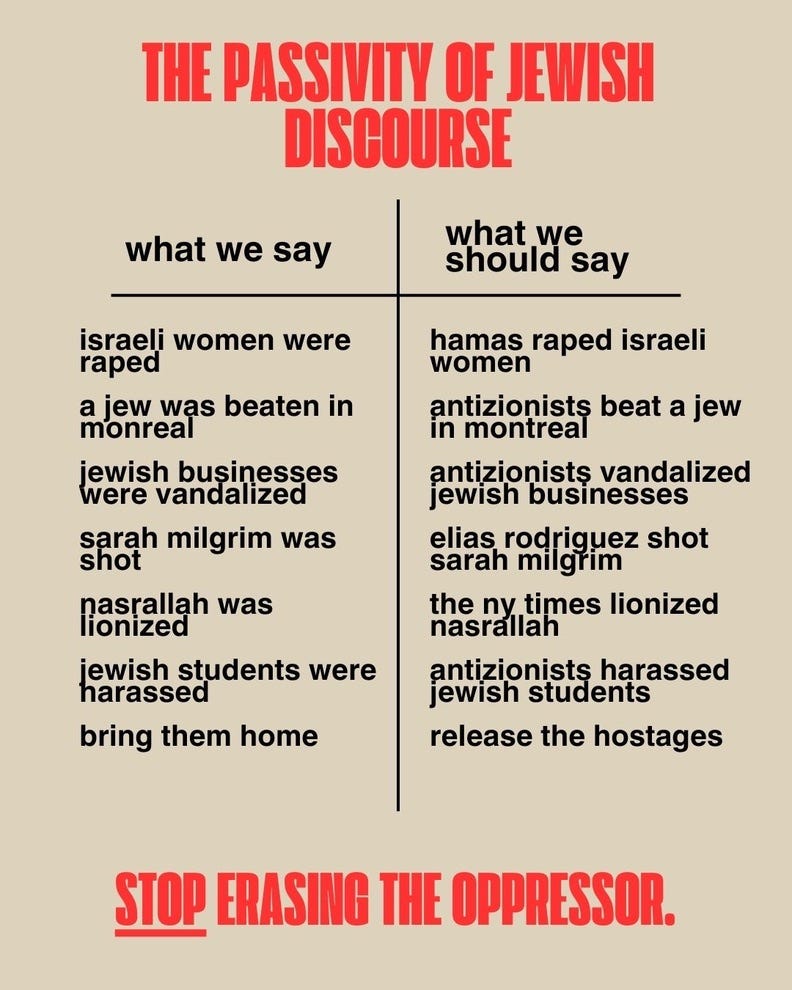
These are weather reports, not analyses. They lack actors, motives, structures, ideologies, and systems. And this linguistic pattern continues even in descriptions of violence. In an eerie way, events happen to Jews, yet no one causes them:
“Israeli women were raped”
“Nasrallah was lionized”
“A Jew was beaten in Montreal”
“Jewish businesses were vandalized”
“Jewish students were harassed”
“Sarah Milgrim was shot”
Such formulations render the harm without rendering the perpetrator. They mimic the structure of meteorological statements (“It rained,” “The streets flooded”) in which no actor exists and no intention is named. Violence becomes a condition rather than an action; Jews become a medium through which harm moves, not subjects whose safety is violated by identifiable agents.
Contrast this with what Jews should say—language that restores agency to those who commit, legitimize, or amplify anti-Jewish harm:
“Antizionists raped Israeli women”
“The New York Times lionized Nasrallah”
“Antizionists beat a Jew in Montreal”
“Antizionists vandalized Jewish businesses”
“Antizionists harassed Jewish students”
“Elias Rodriguez shot Sarah Milgrim”
This linguistic shift restores agency to the actors who commit, legitimize, or amplify anti-Jewish harm. It makes the ideology and its adherents visible. It generates accountability. And crucially, it reorients the public gaze away from Jewish victims and toward the structures targeting Jews.
IV. How Meteorological Language Makes Allies Invisible
Meteorological discourse does more than misdirect Jewish attention; it reproduces the very stereotypes antizionists exploit. When Jews describe hostility as atmosphere—“It’s getting bad out there,” “This campus is terrifying,” “Hate is rising”—we inadvertently cast ourselves as isolated and inward-facing, unable to identify the non-Jewish actors shaping our reality.
This atmospheric framing collapses the entirety of the outside world into a single undifferentiated mass. Antizionists and potential allies blur together into “the World,” not by intent but through trauma-shaped habit. The result is a kind of epistemic claustrophobia: Jews talk about Jews, to Jews, for Jews, without any analytic account of the Other—the perpetrators who create harm or the allies who might intervene. In this perceptual collapse, asking Jews to distinguish between “the helpful ally” and “the antizionist stalker” feels impossible; all external actors appear equally threatening. Without vocabulary that separates perpetrators, collaborators, bystanders, and supporters, every non-Jewish actor becomes part of an amorphous outside, while Jews remain a small, besieged “us.”
V. Turning the Gaze onto Antizionism
The first principle of minority survival politics is simple:
You name the agents and structures that harm you.
Black communities affirmed Black pride, but they confronted racism. Women reclaimed femininity, but they organized against sexism. Queer people asserted queer pride, but they fought homophobia. Identity affirmation helped restore dignity, yet none of these movements confused self-expression with diagnosis. Their power came from describing the hostile structure, not from explaining themselves to it.
Jews have not yet made this shift. We continue to endlessly “explain Zionism” rather than describing antizionism—and further, we keep misdiagnosing antizionism as classical antisemitism instead of recognizing it as a distinct strain of anti-Jewish hate. The result is a treadmill of self-explanation and semantic debate that leads to feelings of futility and exhaustion. Until the Jewish gaze turns outward—toward mapping antizionism as a system rather than defending Jewish identity—effective communal response is impossible.
VI. Why We Need a Detailed Vocabulary of Harm
In addition to naming harm, every successful civil-rights movement has advanced by developing a granular vocabulary that describes the texture of group-based hatreds.
Feminism did not stop at “sexism hurts women.” Racial-justice movements did not remain at “racism is bad.” LGBTQ activism did not settle for “homophobia is wrong.” Each movement built a dense conceptual infrastructure that made the invisible visible and the deniable undeniable.
Racial-justice movements named concepts such as redlining, profiling, school-to-prison pipeline, blackface, and microaggressions. Feminism named patriarchy, date rape, the wage gap, glass ceilings, gaslighting, mansplaining, and sexual harassment. LGBTQ movements introduced outing, conversion therapy, misgendering, heteronormativity, and family rejection.
These lexicons changed the world. They gave advocates tools to identify patterns, mobilize coalitions, demand accountability, and legislate protection. Precision is what makes harm legible to the broader society.
Classical antisemitism once had such clarity. Jews could point to Judeobolshevism, Rothschild conspiracies, ghettoization, pogroms, racial pseudoscience, Jewish-quota laws, Nazi propaganda, Aryanization, and Holocaust denial. These concepts mapped the landscape of danger and enabled Jews to recognize the mechanisms threatening them.
But when it comes to antizionism, Jewish speech collapses. Instead of producing new diagnostic categories to capture a transformed system of anti-Jewish hostility, Jews reach backward and attempt to squeeze contemporary harms into the old vocabulary of classical antisemitism—or worse, they rely on vague abstractions, like “pure Jew-hatred.”
This mutism is not an intellectual failure; it is a psychological one. Jews have not yet formed the moral confidence to name and describe antizionism. And because we lack a lexicon for it, we cannot properly describe what is happening, or ask for help.
VII. Deploying the Vocabulary of Antizionist Harm
A successful movement against antizionism begins by making the structures of antizionist harm visible and by establishing healthy boundaries. This work cannot be sporadic or symbolic; it requires sustained, consistent attention. Public discourse—across social media, traditional media, podcasts, street art, conversations, panels, academic spaces, and beyond—must be saturated with clear descriptions of antizionism and condemnations of antizionist behavior as socially unacceptable. This is how antizionism shifts from something fashionable to something discrediting; how a society learns to recognize a pattern of danger before it escalates into mass violence.
What follows is a streamlined diagnostic typology to guide that work. These categories are descriptive rather than exhaustive, and naming them is itself an act of conceptual reclamation. This vocabulary renders antizionist harm legible both to Jews and to the broader public, transforming scattered experiences of hostility into a coherent system that can be examined.
Antizionist Slurs
Racialized or eliminationist epithets applied categorically to “Zionists”: “Zio,” “Zionazi,” “Baby killer.”
Antizionist Libels
Obsessively repeated accusations portraying Israel or Jews as foreign, malign, or uniquely criminal: “Settler-colonizer,” “Apartheid,” “Genocide,” “Ethnostate,” “Zionism = racism.”
Antizionist conspiracies
Allegations that “Zionists” or “AIPAC” manipulate institutions or global events, including claims that they control media, finance, governments, climate systems, or are responsible for domestic issues such as poverty, homelessness, police violence, or healthcare failures.
Antizionist White-Coding
Collapsing the diversity of Jewish identity into racist caricatures of “whiteness” in order to erase minority status or rationalize hostility.
Antizionist Purges and Exclusion
Exclusionary practices that remove Jews from institutions unless they denounce Israel: firing, disinviting, or excluding Jews who refuse to participate in antizionism; coalition expulsions; litmus tests.
Antizionist Harassment of Visibly Jewish People
Targeting individuals on the basis of recognizable Jewish identity markers, such as attacks on people wearing Jewish symbols, campus intimidation, or antizionist mobs confronting synagogues.
Antizionist Vandalism and Property Attacks
Damage to Jewish communal or private property accompanied by ideological messaging, including graffiti (“Zionists out,” “From the river to the sea”), defacement of synagogues or JCCs, and destruction of Jewish-owned property.
Antizionist Violence
Physical assaults or attacks justified in the name of antizionism, including assaults on individuals, attempts to storm synagogues or communal institutions, and stabbings, shootings, or firebombings presented as “anticolonial resistance.”
VIII. Why Jews Resist Naming Antizionism
Jewish resistance to naming antizionism emerges from overlapping historical, psychological, institutional, and political forces. These pressures interact and reinforce one another, producing a communal reluctance that no civil-rights movement can afford:
The “Don’t Make It Worse” Survival Strategy
For much of Jewish history, silence functioned as a necessary survival strategy. In societies where Jews lacked civic rights, institutional protection, and meaningful recourse against hostile majorities, speaking publicly could trigger violence or expulsion. Keeping a low profile was not a sign of timidity but a rational adaptation to conditions in which visibility carried existential risk. That long historical pattern—shaped by trauma, inherited memory, and generations of social conditioning—still informs contemporary hesitation and remains embedded in our communal nervous system.
The present landscape, however, differs markedly from earlier eras. In liberal democracies, Jews participate as full citizens, operate within legal frameworks that protect minority rights, and interact with established civil-society institutions capable of responding to discrimination—conditions that alter the calculus of risk and allow for forms of public articulation that were historically unavailable. At the same time, antizionism now circulates through global, digitally networked channels in which silence cannot mitigate algorithmic amplification, misinformation flows, or online harassment. Under these dynamics, silence does not prevent harm; it creates interpretive gaps in which external narratives take on greater force. Understanding this shift illuminates why inherited modes of caution, while historically intelligible, are calibrated to a threat environment that no longer resembles today’s reality.
Fear of “Dual Loyalty” Accusations
For generations, diaspora Jews lived under the shadow of one of the most persistent anti-Jewish accusations: that Jews are more loyal to each other—or to a foreign power—than to their own country. This suspicion has existed in every society Jews have ever lived in, from medieval Europe to modern liberal democracies. In this context, many Jewish institutions still tread carefully. Even ordinary expressions of connection to Israel can trigger scrutiny, leading organizations to downplay Jewish peoplehood, sovereignty, or collective interests. In moments of crisis, this inherited fear can make institutions slow to call antizionism what it is—not because they fail to recognize the danger, but because they remain wary of being cast as outsiders within the countries they call home.
The fear of being seen as “right-wing,” “tribal,” or “illiberal”
For much of the twentieth century, diaspora Jews—especially in the U.S., U.K., and Canada—were able to cultivate identities centered on gentleness, civic virtue, and universalist ethics precisely because they lived in societies that protected their rights for them. Rooted in social justice, liberal universalism, minority solidarity, and a commitment to not resembling ethnic nationalists, these communities could afford to keep questions of power, sovereignty, and collective defense at arm’s length.
Israelis never had that luxury. For Jews who survived genocide, expulsions, and relentless persecution across Europe, the Middle East, and North Africa, a Jewish state was not an abstract project but the only path to physical safety. Their everyday reality involved confronting borders, security, and survival in ways diaspora communities—shielded by far stronger nations—never had to contemplate. This creates a profound friction today: naming antizionism as a hate movement feels, to many diaspora Jews, like abandoning universal ideals in favor of particularism, nationalism, boundary-setting, and prioritizing Jewish safety. It collides directly with the identities they’ve spent generations constructing.
Denial as Psychological Defense
Naming antizionism forces a reckoning many Jews are not prepared to face: that systemic hostility persists, that institutional belonging may be fragile, and that long-assumed social acceptance was never guaranteed. For those who spent decades proving themselves as the model minority—aligning with every cause, avoiding offense, demonstrating universal solidarity—the realization that many “allies” never saw them as equal partners is emotionally devastating. Denial becomes a psychological refuge, a way to avoid acknowledging that relationships built on loyalty and moral clarity were never fully reciprocal.
This resistance is strongest among Jews shaped by assimilation narratives: the belief that acceptance in the West was earned through civic virtue, good conduct, and moral alignment. Naming antizionism threatens this story by revealing that even the most integrated, contributing Jewish communities can still be targeted. Confronting that truth feels like a rupture not only in politics, but in identity—so the mind clings to the comfort of disbelief long after the evidence is overwhelming.
Political Resistance to a Civil-Rights Framework
Resistance also arises from ideological anxieties on both ends of the political spectrum, which—despite their differences—produce the same outcome.
A. Left-Leaning Resistance
Progressive Jews fear that adopting a civil-rights framework will make them appear to seek victimhood, compete with other marginalized groups, appropriate civil-rights language, or disrupt intersectional hierarchies. Their reluctance emerges from privilege narratives and discomfort with Jewish particularity.
B. Right-Leaning Resistance
Conservative Jews reject civil-rights framing because they associate it with “wokeness,” identity politics, structural analysis, and systems theory. They favor individual-level accounts of anti-Jewish hate and distrust frameworks that foreground ideology or power.
C. Combined Effect
These opposed anxieties converge into a single barrier: left and right alike refuse the very framework every other minority group has used to understand and confront systemic violence. The result is conceptual paralysis and the absence of a Jewish civil-rights vocabulary.
IX. Toward a Jewish Civil-Rights Consciousness
For generations, the habits described above were adaptive strategies. They helped Jews survive under conditions where direct accusation invited retaliation and where safety depended on invisibility, ambiguity, and self-containment. But those strategies no longer serve us. In a world where antizionism functions as an ideological system rather than a series of isolated prejudices, the survival tools of the past have become liabilities. What protected earlier generations now obscures the forces acting upon us. To meet the present moment, we must consciously relinquish these inherited reflexes and cultivate new ones: clarity over deference, analysis over apology, naming over euphemism, and agency over fear. This is not a call for militancy, but for a sober and mature political awakening—a collective reorientation toward reality. It is, in the deepest sense, a spiritual renewal: a move from the posture of the frightened defendant to that of a people willing to see the world as it is and to speak about it in the language it requires. Only by breaking these old habits can we build the conceptual, moral, and communal infrastructure necessary to stop treating antizionism as “weather,” and start confronting it effectively.
Modeling Effective Advocacy
This week’s recommended reading is Kathleen Hayes’s “Antizionism: The Reinvention of a Racist Hate Movement,” a strong example of the advocacy our framework calls for. Instead of rebutting accusations or “explaining Zionism,” Hayes names antizionism directly as a racist, eliminationist system and identifies the actors and structures that sustain it. She restores agency to perpetrators, sets clear moral boundaries, and reframes the issue in civil-rights terms—showing that antizionism is not a misunderstanding but a system of harm that must be exposed and confronted.
Antizionism in the Wild
Last week, antizionists gathered outside a synagogue in New York City, chanting “intifada” and calling to “make Jews scared.”
POLL
How are they best described?
Pro-Palestinian protestors
0%
Antizionist hate-mob
98%
Critics of Israel
2%
44 VOTES · POLL CLOSED
Take Action
As antizionism continues to advance across cultural, academic, and civic spaces, it can be difficult to know how to respond. Below is a set of concrete actions that individuals can take to better understand this ideology and help counter its growing influence.
Learn about antizionism and how it operates today.
Watch Dr. Naya Lekht’s talk on why focused attention on antizionism is essential.
Test your understanding with our interactive antizionism quizzes.
Share your personal story for the upcoming MAAZ limited podcast series, Stories of Antizionism.
Respond to an antizionist incident in writing.
Contact your elected officials about antizionism.
Join the MAAZ community stickering campaign to make a local impact.
Follow the Institute for the Critical Study of Antizionism on X.
Show your support for MAAZ by visiting our merch store.
Your insight and participation are vital to this evolving project. We invite readers to engage with this dispatch, share their reflections, and propose areas for future inquiry.
With appreciation,
The Movement Against Antizionism (MAAZ)
Note: The Movement Against Antizionism (MAAZ) is in the process of obtaining 501(c)(3) nonprofit status and will soon be able to accept tax-deductible donations. If you are interested in supporting our work, please contact us at exec@maazaction.org.
=====
(2)
https://elderofziyon.blogspot.com/2025/12/there-is-no-epistemological-difference.html
Elder of Ziyon
There is no epistemological difference between academic Israel studies and conspiracy theory
In my last post I started realizing that academic Israel discourse is based on the “coherence theory” of truth, not the alternatives like that used by science - the “correspondence theory.”
Briefly, the coherence theory says that a statement is true if it is consistent with a larger system of beliefs. The correspondence theory says that a statement is true if and only if it corresponds to, or accurately reflects, a fact or state of affairs in the objective world.
Hard sciences use the correspondence theory. A survey of scientific academic papers show that they use language like “data collected from,” “quantitative analysis,” “survey results,” “statistical significance,” “measured,” “null hypothesis” or “empirical.” Fields like economics which are not quite as predictive as hard science also uses correspondence theory language. An extremely high percentage of scientific papers use one or more of these terms in their abstracts.
Social science likes to pretend that it is like a hard science, but at least in the Israel context, this language is almost entirely absent in the sample of abstracts I had AI analyze. Instead it uses phrases like “must acknowledge,” “irrefutable,” “undeniable,” “only path,” “systematic,” “structural,” “urgent,” or “the real reason,” language that tries to paper over the lack of hard facts with assertions.
In the case of academic analysis of Israel, this is because there is already an established belief system: that Israel is malign by definition. Anything that is consistent with that belief is accepted as strengthening the belief system itself; anything that contradicts that belief is dismissed or re-interpreted to fit the belief.
So, as we saw in the last post, when Israel’s president said that all of Gaza bears responsibility for the environment that enabled October 7, that quote is taken as proof of genocidal thinking - while in the very same speech he said clearly that civilians are not to be harmed. The latter statement is ignored, because it does not cohere with the prior belief.
We saw the same with Netanyahu’s references to Amalek — even though he explicitly quoted the commandment to remember, it is assumed that he meant annihilate - because the coherence framework allows only one possible interpretation.
That’s why academics can claim that Israel is still committing “genocide” even after the war is over. Empirical facts are not important against the narrative - the stability of the coherent belief systems.
This is not simply a disagreement about facts. It is a disagreement about how truth itself is determined.
Coherence theory is often presented as a legitimate alternative theory of truth. But it isn’t merely different — it is epistemologically broken. The reason is simple: Coherence theory is not falsifiable.
In correspondence-based reasoning, if evidence contradicts a claim, the claim must change. In coherence-based reasoning, if evidence contradicts a claim, it is interpreted as misleading, irrelevant, or morally compromised.
This sounds very familiar to those of us who have analyzed antisemitism - because this is the exact mental structure of conspiracy thinking.
Once a field abandons falsifiability - the ability to test a claim against reality and risk being proven wrong - it becomes epistemologically indistinguishable from conspiracy theory.
In a conspiracy model, contradictory facts are reinterpreted as evidence of the cover-up. In a coherence-driven academic model, contradictory facts are reinterpreted as irrelevant, misleading, or morally suspect.
A conspiracy theorist says, “The lack of evidence proves how deep the conspiracy goes.”
A coherence theorist says, “The contradictory facts are irrelevant because they don’t align with what we know about colonial power structures.”
These are functionally identical.
This is not about Israel alone. It affects broader academic domains like identity studies, post-colonial studies, critical race theory, and much of gender theory. When a model becomes too elegant - when it explains everything, and can survive any contradiction - that is when it stops being scholarship and becomes dogma.
Falsifiability is the immune system of truth. If a claim can never be wrong, then it is not science, nor history, nor scholarship. It is theology without God.
People who operate within coherence-based frameworks are often sincere, intelligent, and genuinely unaware of the epistemic trap they are in. Their entire thinking process is wrong but this is how they are trained, how their fields operate. If the underlying theory of truth is wrong, then entire disciplines built upon it are on unstable foundations. Confronting that feels existential to them, so resistance is natural.
But this confrontation is necessary. Unless we return to falsifiability, to the kind of truth that can be tested, challenged, and corrected, we are training generations of students to confuse ideological coherence with actual reality. And life changing political and policy decisions are being made based on frameworks that cannot be wrong because they cannot be tested.
That should concern all of us.
=====
(3) This podcast will blow your mind and terrify you.
=====
That’s it for now — remember, spread the word!
AP
Excellent piece. More like this. Thank you for your clarity and vision.